Reinvent the work. Prove the value.
Turn AI ambition into measurable operating value.
Cognitive Partners redesigns critical workflows around people, automation, and AI—then embeds the new way of working and measures what changed.
Find the workflow worth transforming
The pilot is not the transformation.
Most organisations do not have an AI-ideas problem. They have a value-realisation problem: promising pilots sit beside fragmented processes, unclear ownership, legacy constraints, and day-to-day work that has not actually changed.
Cognitive Partners starts with the work—where value is constrained, how decisions and exceptions really move, and what must change across operations, technology, people, risk, finance, and governance.


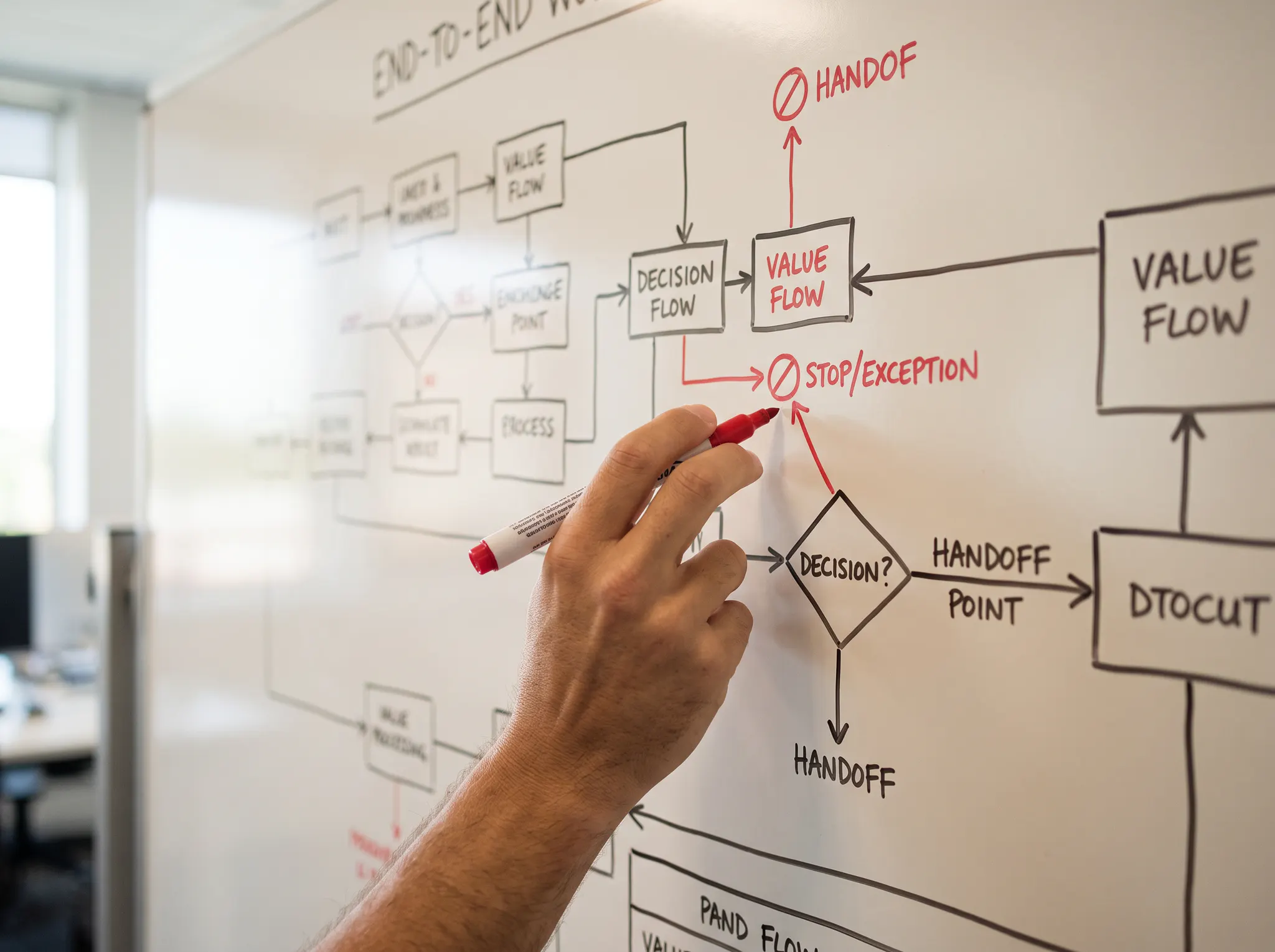
Start with the work.
Define value before selecting a solution. Redesign the whole workflow. Apply only the intelligence the outcome requires. Prove the result before scaling.
- 01
Define value
Name the outcome, owner, baseline, constraints, and evidence standard.
- 02
See the work
Reveal the real flow, decisions, exceptions, rework, and control burden.
- 03
Redesign
Reconsider the end-to-end workflow around people and machines.
- 04
Apply AI
Use the smallest responsible combination of AI, automation, data, and integration.
- 05
Enable adoption
Embed roles, capability, governance, management routines, and feedback.
- 06
Prove
Track performance, real use, workflow movement, business outcome, and financial effect.
- 07
Scale
Expand only when the evidence, controls, ownership, and economics justify it.
Measure what the operation feels.
The score is an agreed business measure—not the number of models deployed, prompts written, or theoretical hours “saved”.
From process truth to intelligent operations.
A connected path for moving from a material constraint to working change and decision-grade evidence. Scope and entry point should follow the client’s readiness and evidence.

- 01
Process and Value Diagnostic
Where can AI create material value, and what should we do first?
- 02
Intelligent Workflow Blueprint
What should the work become before we build?
- 03
Applied AI Delivery
Can the redesigned workflow work responsibly in your environment?
- 04
Augmented Workforce Enablement
Will people adopt, govern, and improve the new way of working?
- 05
Value Realisation and Scale
Did it work, what value was realised, and what should scale next?
Technology in service of the outcome.

- 1
Technical
Quality, safety, latency, reliability, and unit cost.
- 2
Adoption
Real use, workflow penetration, acceptance, and sustained behaviour.
- 3
Operational
Cycle time, throughput, rework, service, exceptions, and control effort.
- 4
Business
Customer, revenue, margin, capacity, risk, or another strategic outcome.
- 5
Financial
Realised benefit net of implementation and run costs, with agreed attribution.
A case belongs here only when the baseline, intervention, period, adoption, operating movement, full costs, and attribution are clear. Until then, the method—not an invented percentage—is the proof.
Which workflow is holding back value?
Start with the operating constraint—not a catalogue of AI possibilities. Tell us where speed, quality, capacity, cost, control, service, or growth is under pressure.